Favorite Scissors

Working with scissors that just won't cut the mustard can put a little stress in the sewing room and on the joints in our hands. About a year ago, I was perusing Quilt Market and came across the Kai Scissors booth. There were no sparkles or dazzling displays...only simple tables filled with perfectly aligned scissors. I stopped and focused on the different sizes and shapes of scissors. But the love happened when I picked up a pair of Tailoring Shears and the gentleman handed me a piece of fabric to cut. First of all, the feel and comfort was so different than any other scissor I had ever held. I could sense the quality just by opening and closing them, but I was totally amazed at how they cut! I couldn't even feel the fabric between the blades. So...I placed my order for a few pair, just to try.


When I returned home and my order arrived, I was eager to use them in my sewing room. I will admit that I am a bit of a scissor junkie. I set out to test them as I made a heavy tote bag. I always use an interlining of heavy cotton canvas and batting between the facing and lining fabrics. Admittedly, this is sometimes hard to trim, especially in seams. These scissors cut right through all of it like butter! There was no strain on my hand and no stalling by the scissors. I was completely in love! So I placed a larger order for the store...gave all my employees & sewing family members a pair for Christmas, and removed my rotary cutters from our shop's cutting tables and replaced them with Kai scissors! (Boy, do I save money on rotary blades!).

So, let me introduce to you Kai scissors...the best in the world! Made in Japan from fine stainless steel for extra long life and high cutting efficiency. The duplex interlock screw makes the blade tension last; I've used mine heavily for over a year and they still cut just as fine as when they were brand new. Detailed below, but you can find more information about each pair on my shopping page.


A: Model 7230 9" Tailoring Shears. Great for trimming quilts and layers of fabric. I use these for general sewing use as well. My 'go to' scissors.

B: Model 7205 8" Tailoring Shears. A shorter version, every bit as wonderful as 'A'.

C: N5100C: A small 4" scissor with curved blades for trimming close to the fabric. Great for machine or hand embroidery. The blades are serrated, for trimming fabric close to applique´stitches.

D: N5100: A small 4" scissor just like 'C', but with a straight blade. These are great for the sewing box and trimming threads when hand sewing.

E: N5130DC: Double Curved scissors. The handles are curved, and the blades are curved for easy cutting of hooped fabrics. The tips are blunt so that you won't accidentally cut the fabric. Wonderful for all types of embroidery or quilting.

F: N5000: 5 1/2" scissor for general embroidery. Ergonomically soft handles make cutting easy on the hands.

Thanks for visiting today! Happy sewing and God bless!

Maxie


Layer and Quilt as Desired. (?)

Those five little words seem to be the last sentence in just about every quilt pattern instruction sheet, yet this part of the process might take longer to accomplish than all the previous steps in the pattern! Sometimes things really are easier said than done. So, I thought today I'd share some tips that I've learned over the years that might help you with this arduous task. Well, at least with the 'layer' part!

First of all, you need to begin with a very straight, squared up and on grain backing. The best way to do that is to tear your backing on all four sides. Or, you could leave the selvages on the two lengthwise sides and only tear the two crosswise sides. In the sample above you can see that I needed to sew a seam in my backing because my quilt was wider than the width of fabric. By the way, your backing should extend about 3" beyond your quilt top on all four sides. You can achieve this by adding 6" to the finished length and width of your quilt top. For example: if your quilt top is 50" x 50", make your backing 56" x 56". (If you're making your backing for a long arm quilter, typically they will ask you to add 8".)

Using masking or painter's tape, tape the two lengthwise sides (opposite from each other) to a smooth surface. Make sure your backing is wrong side up. I'm using my hardwood floor, but you could use a table. Tape them taught, but don't stretch the fabric. Then, tape the two crosswise sides. (See above photo.) You can gently tug out any loose fabric areas, but don't stretch here, either. If you skip the tape, you will most likely experience pleats and puckers on the back side of your quilt!

The next step is to smooth your batting on the backing fabric. Batting typically doesn't have a grain. Your backing should extend about 2" beyond your quilt top on all four sides.

Roll, or fold up your quilt top as shown above. Lay a ruler on the edge of the quilt, with the 3" line on the edge of the backing. Place the quilt top on the batting, aligning the edge right next to the ruler. If you have more than a 3" extension, that's ok, just make sure you use a ruler, as pictured, to help keep your quilt top and backing straight.

Unroll your quilt, smoothing as you go. Want this pattern?? Watch for next Tuesday's post!

Time to baste. There are several basting methods, but I prefer pin basting because it's a pretty fast process. Slip a small rotary cutting mat underneath the backing to pin into and protect your floor or table. Place a safety pin about every 5-8" apart. Try to avoid areas where you'll be placing quilting stitches. If I plan to stitch in the ditch, for example, I avoid placing pins in the seams. Remove pins as you quilt.

After pinning, untape your quilt from the floor. Now you can 'quilt as desired'!  Maybe we'll cover that in another post! Thanks for visiting and God bless,

Maxie

Using Beautiful Ribbon

Renaissance Ribbons makes the most beautiful ribbons. Period! Their ribbons make everything prettier! They collaborate with fabric designers, which makes coordinating projects easy as pie. Among their designers are  Amy Butler, Tula Pink, Dena Designs, Anna Maria Horner, Sue Spargo, and my personal favorite, Bonnie Christine! Renaissance Ribbons has lots of free project ideas on their website, including a pretty Pull Out Box made from Bonnie's ribbon collection.

I thought I’d share a little inspiration that might whet your appetite to grab up a little bit of this silkiness and beautify your next project! We’ll begin with my newest, favorite project (which is always what I’ve just finished making)! Seriously, this is a very sweet wallet, the Diva Frame Wallet from Jessica VanDenburgh of Sew Many Creations. She also markets the hardware, which was surprisingly easy to work with. You’ll find both items on my shopping page. This wallet, made from Bonnie Christine’s fabric, is trimmed in one of her ribbons. She currently has 11 ribbons that coordinate with all of her fabric lines. By the way, Bonnie and I are counterparts today; she's posting about ribbon today, too! (The wallet below: a surprise for Bonnie!)

ribbons_4.jpg


Think she'll like it?

Here are a few more ideas, and a delightful book by Elaine Schmidt, overflowing with captivating ribbon projects. You can download our pattern for The Perfect Whatever Bag, pictured below, free! What would you like to do with beautiful ribbon?

ribbons1.jpg

Thanks for visiting! Let's go make our world a little prettier! God bless,

Maxie


How to Match Fabric Patterns in Seams

Many times a seam is required to make strips or borders long enough for our quilting projects. When using a patterned fabric, sometimes those seams are less than attractive, and if I know it's there, my eye falls right to it before it sees anything else! Here's a little tip to make those seams invisible! I use this technique almost every time I have to sew patterned fabric together. (I have a video planned to show you how to piece a quilt back with an invisible seam!)

Step1

Sometimes we can get away with a diagonal seam to camouflage the join, but not so with this fabric.

IMG_3436.JPG

I cut the two strips shown above in the same place from the yardage. (meaning that I used the same rows of bugs for each strip. Doing this ensures that I can find a spot in the pattern repeat where the bugs will line up exactly.) Make a nice, straight cut across the fabric at the end of one of the strips.

Using a spray starch alternative (Flatter is my favorite; plant based, no toxic stuff in my fabric), press the edge that you just cut to the wrong side of the fabric.

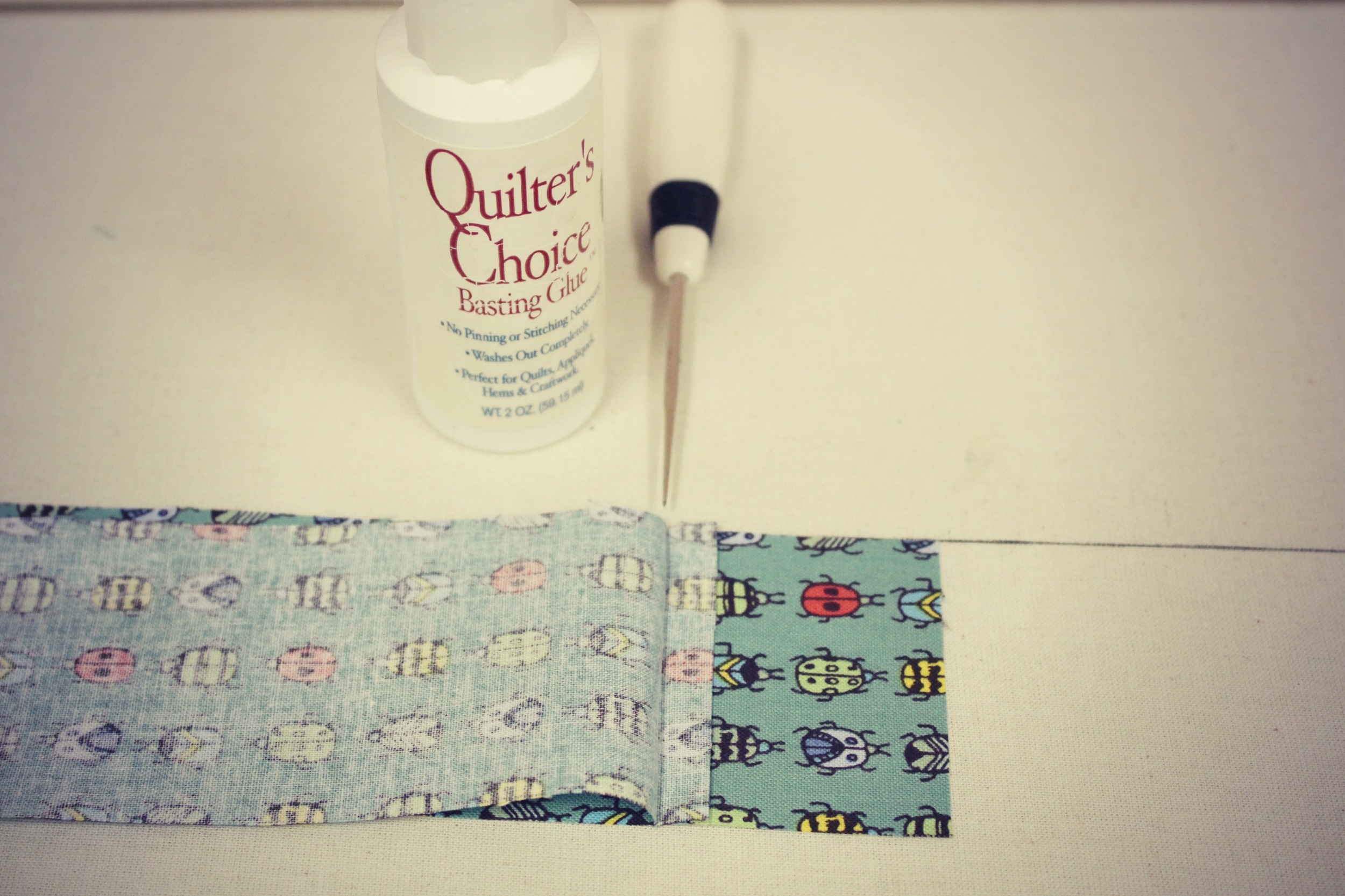
Look closely at the spot the stylus is pointing to...I've lined up the bugs perfectly by finding where that pressed edge matched the pattern in the strip I want to attach it to. The next step is to use a fine line of basting glue to hold the edges together. I've not pictured this step, but lift up the top folded edge and place the glue just on the underside edge of the fold. Use only a very thin line of glue. Carefully replace it and press it with the iron to dry the glue.

Here's a look at the two strips glued together, with the top strip flipped back so that you can see the nice crease that pressing has made.

IMG_3452.JPG

Take the strips to the sewing machine and stitch them together, right in the crease. Trim the excess fabric away, leaving a 1/4" seam allowance.

Done.

Thanks for visiting!

Friday's Feature

Today is Friday. My objective for this space is to share a new technique and a featured item each week with you. Modeled after a fun weekly event that I offered at my Quilt Shop for several years, Tuesday will be for Tuesday's Technique. Fridays will be for Friday's Feature...so today I want to share one of my favorite products with you! When applicable, the item will be added to my shopping page for your convenience. Sign up for email updates (right) and you'll always be up-to-date!

Ah...Aurifil Threads! A favorite of quilters everywhere, this Italian thread is smooth as butter and always consistent. Although the company makes several different  weights and types of thread, my personal favorite is the 50wt cotton. This weight is marketed for both hand and machine work, and comes in a full spectrum of colors. It's wonderful for piecing, quilting, applique´, embroidery and more! Aurifil collaborates with fabric designers and quilters to create color collections. Pictured above is my daughter's collection, Sweet as Honey, which Aurifil released last year. My suggestion is that you consider picking a collection that appeals to you and you'll find yourself using every color in it! I've added a 4 spool collection of basic colors by Edyta Sitar to my shopping page.

Thanks for visiting today!